Your Trusted Custom Golf Cart Bags Manufacturer
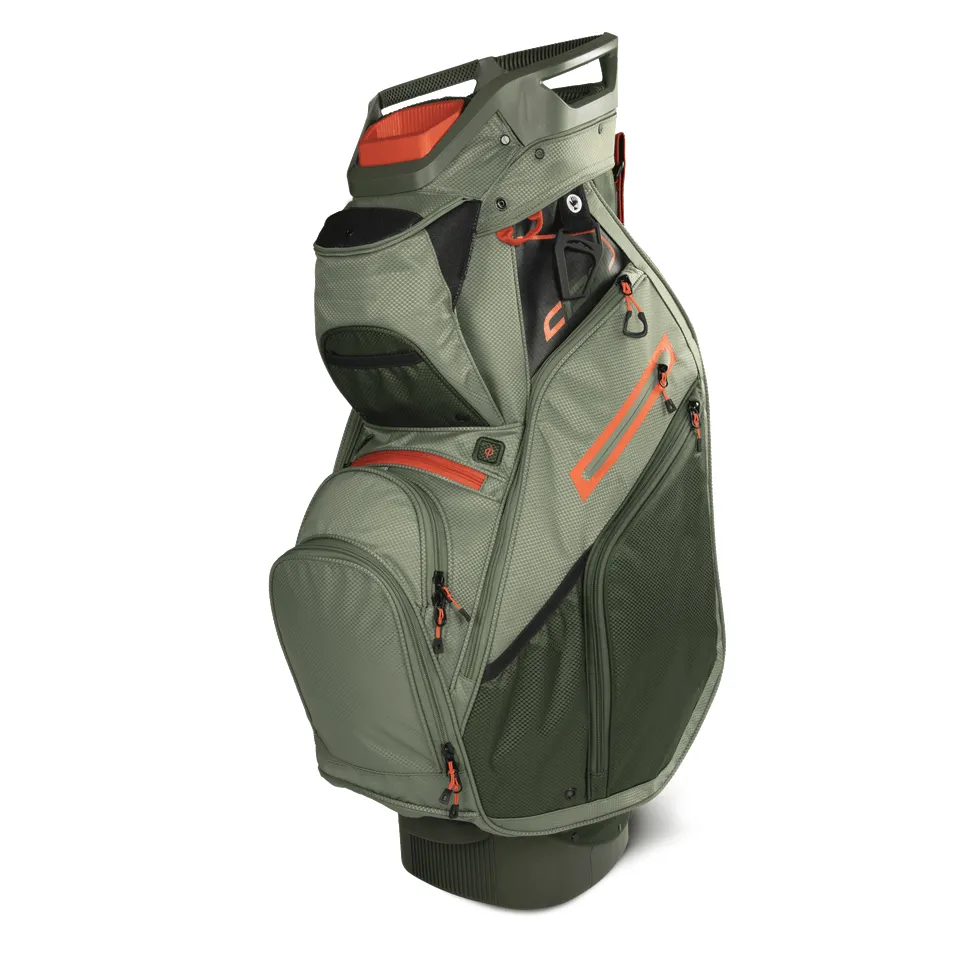
Custom golf cart bag manufacturing with cart strap pass-through planning, stable base compatibility, and pocket access mapped for real cart use.
Spec snapshot
A fast engineering view of what matters for sourcing, quoting, and repeatable production.
| Item | Typical | Notes |
|---|---|---|
| Cart interface | strap pass-through (by spec) | Prevents pocket blockage and keeps valuables accessible on cart |
| Base compatibility | cart base + anti-slip (by spec) | Controls tipping and deformation under strap tension |
| Pocket access goal | usable while strapped | Map openings away from strap paths |
| Organizer layout | 14-way optional (by spec) | Premium organization adds structure parts and tolerance control |
| Typical MOQ | 500–800 pcs | Depends on materials, structure parts, and branding package |
Cart interface blueprint
Cart bags must work while strapped. This blueprint maps the interfaces that control access, stability, and repeatable bulk execution.
| Interface | Why | Spec |
|---|---|---|
| Strap pass-through tunnel | keeps pockets accessible | define tunnel height and reinforcement map to avoid panel collapse |
| Anti-slip cart panel | prevents strap slip | choose anti-slip fabric and validate abrasion and staining (by spec) |
| Handle placement | easy lift to trunk/cart | top + mid handle aligned to CG with pull-test targets |
| Umbrella sleeve (by spec) | weather usability | sleeve opening orientation should not conflict with cart strap |
Strap pass-through mapping
Strap routing decisions determine whether pockets stay usable on carts. This map standardizes geometry and QC gates.
| Zone | Design | Risk | Control |
|---|---|---|---|
| Upper strap path | pass-through above valuables pocket | pocket blocked by strap | strap route test with common carts and pocket opening map |
| Mid strap path | stabilized tunnel + anti-slip backing | panel deformation | reinforcement patch planning + strap tension validation |
| Lower strap path | base seat alignment | bag tilts under load | base compatibility checks and loaded stability sampling |
Cart base compatibility
Cart bags fail when bases deform or tip with loaded pockets. These controls keep stability predictable under strap tension.
| Factor | Impact | Fix | QC gate |
|---|---|---|---|
| Base footprint | tipping risk when pockets loaded | wider footprint + anti-slip panel (by spec) | loaded stand/cart stability check |
| Cart seat interface | deformation under strap tension | reinforced cart panel and tunnel geometry | strap tension test with pocket access verification |
| Pocket bulge control | top-heavy behavior | pocket zoning and volume caps (by spec) | loaded pocket simulation and appearance gate |
Pocket access grid (on cart)
Cart usability is a pocket access problem. This grid keeps openings reachable while the bag is strapped to a cart.
| Access on cart | Risk | Control | |
|---|---|---|---|
| Valuables pocket | reachable under strap | blocked opening | rotate opening away from strap path; validate with cart strap |
| Apparel pocket | side access | bulge and tilt | zoning and base angle strategy; cap pocket depth |
| Ball/tee pocket | front one-hand access | over-pocketing adds labor | pocket count vs sewing time review |
| Cooler pocket (by spec) | side access | leak and odor | liner spec validation and cleaning guidance |
Capacity & dimensions reference
Standard size options for golf cart bags. We can also customize dimensions to fit your specific gear.
| Volume | Typical Dimensions | Best For |
|---|---|---|
| Cart series | larger pocket zoning | cart-focused retail series and club programs |
| Organizer top (by spec) | 14-way + putter well | premium organization and higher ASP |
| Hybrid cart-ready (by spec) | balanced weight | brands needing one SKU for mixed use |
Materials & fabrics
Material choice drives performance, durability, finishing, and target price point.
| Fabric | Waterproof | Cost | Notes |
|---|---|---|---|
| PU leather / synthetic leather | depends on finish | varies | Premium appearance with controlled grain and color. |
| Polyester / nylon | water-resistant options | varies | Durable shells with good structure support. |
• cart strap route validation (by spec)
• appearance checks
• AQL final inspection
• Club programs
• Distributors and private label
• Strap pass-through preference and pocket access priorities under strap tension
• Divider layout requirements (14-way/putter well by spec)
• Pocket priorities (valuables/apparel/cooler by spec) and access map needs
• Base compatibility expectations and tipping tolerance with loaded pockets
• Branding package and retail packaging requirements
Start custom golf cart bags production
Send your requirements and get a structured RFQ checklist and a manufacturing plan.
A cart-mounted bag spends its life strapped to a moving frame, facing sideways to the user and exposed to whatever the weather does for four hours. That reverses two design rules from carry formats: the base must lock to the cart rather than resist dragging, and every pocket has to open towards the person walking behind. Most of the engineering sits in the base moulding and the pocket orientation.
Specification options for custom cart bags
Below is the configuration grid we quote against. The strap pass-through and the base geometry are the two lines to resolve first — they determine whether the bag sits square on the cart or rotates under braking.
| Parameter | Standard cart | Deluxe cart | Premium cart |
|---|---|---|---|
| Divider configuration | 14-way moulded top | 14-way moulded top, velour-lined | 15-way moulded top with putter well |
| Top diameter and height | 24 cm, 91 cm | 25 cm, 92 cm | 27 cm, 92 cm |
| Shell fabric | 600D polyester, PU back | 840D polyester, TPU back | 1200D with PU leather panel and piping |
| Base moulding | Flat keyhole base, 4 feet | Keyhole base with cart-lock tab | Wide keyhole base, skid plate, 5 feet |
| Strap pass-through | Webbing tunnel, 50 mm | Bound tunnel with grip patch | Moulded channel with grip pads |
| Pocket count | 7, forward-facing | 9, including 1 insulated | 11, including 2 insulated and 1 velour |
| Insulated pocket | Not included | 2 L, welded PEVA liner | 4 L welded liner with drain eyelet |
| Accessory fittings | Towel ring, glove patch | Towel ring, umbrella sleeve, glove patch | Towel ring, umbrella sleeve, rangefinder pocket |
| Rain hood | Not included | 210D hood with elastic hem | 210D hood, cinch cord and drainage eyelet |
| Empty weight | 3.0 kg | 3.6 kg | 4.3 kg |
| Tooling budget | USD 900–1,800 | USD 1,200–2,000 | USD 1,800–2,500 |
| Documented compliance | REACH (EC 1907/2006), Proposition 65 | REACH, CPSIA, amfori BSCI | REACH, CPSIA, amfori BSCI, OEKO-TEX Standard 100 |
How a cart bag is built
The base is engineered rather than chosen. A cart base is flat on the underside with a keyhole slot that engages the cart's lower bracket, plus a moulded skirt that wraps the first 40 mm of the shell. Without the keyhole, the bag pivots; with it, the whole load path goes through the moulding, so the moulding is the single part most worth spending on.
The strap pass-through is a tunnel of shell fabric or webbing running behind the pocket stack. It has to be wide enough for a 50 mm cart strap and positioned so the strap does not compress a pocket when tightened. On a moulded version the channel is formed into the base and carries grip pads, which is why that variant sits at the upper end of the tooling range.
Pocket orientation is the defining difference from a carry product. Every pocket that the user needs during play faces outward from the cart, so the ball pocket, the valuables pocket and the insulated pocket are all set on one face of the shell rather than distributed around it. That concentrates weight on one side, and the base moulding is weighted to compensate.
Insulated pockets are built as welded sub-assemblies. A PEVA liner is high-frequency welded at the seams, given a 3 mm foam wrap, then set into the shell opening and taped. A sewn insulated pocket leaks at the needle holes within a season, and there is no way to repair it once the shell is closed.
The top cuff carries both the dividers and, on premium builds, a separate putter well sized for an oversized grip. Ports are moulded with a radius at the entry so a graphite shaft does not catch, and the cuff is riveted to an internal ring that spreads the club load into the shell.
Cost drivers and MOQ for cart bags
Tooling comes first, as on any moulded-top product: a top cuff plus a keyhole base lands between USD 900 and 2,500. Then pocket count, because each pocket is a sub-assembly with its own zip, lining and topstitch operations. Ten pockets is not twice the cost of five, but it is materially more than seven.
| Tier | Typical configuration | Indicative FOB |
|---|---|---|
| Entry | 600D shell, 14-way top, 7 pockets, no insulation | USD 18.00–26.00 |
| Mid | 840D shell, 9 pockets, insulated pocket, hood, umbrella sleeve | USD 26.00–36.00 |
| Premium | 1200D with PU panels, 11 pockets, putter well, moulded channel | USD 36.00–52.00 |
Opening quantity is 500 units per style per colour, dropping to 300 on repeats once tooling and markers are in place. Sampling takes 6–10 working days on adaptable tooling and 12–15 where a new cuff or base is cut, with fees of USD 50–150 credited against the first bulk order. Payment runs T/T 30/70 on FOB Xiamen, with EXW, CIF and DDP available under Incoterms 2020, and pricing is returned within 24–48 hours of a complete brief. Transit is 25–35 days by sea, 5–8 by air and 3–5 by courier. Because the moulded base and top cuff prevent nesting, cartons are sized to the external envelope: plan on 28 CBM per 20GP, 56 CBM per 40GP and 68 CBM per 40HQ.
Quality gates and acceptance criteria
Inspection is run to AQL 2.5 sampled under ISO 2859-1 — Critical 0, Major 2.5, Minor 4.0 — with AQL 1.5 available where a retail protocol requires it. Documentation is issued from our 4,950 m² SGS-verified production floor before loading and repeated in the same format on reorders.
Functionally, the tests that predict warranty performance are cart-strap abrasion, rotation resistance under a braking load, base impact with a full set, and rain behaviour of the shell and hood. Cosmetic inspection catches nothing of those four.
| Check | Method | Acceptance |
|---|---|---|
| Cart strap abrasion | ISO 12945, 20,000 rubs on tunnel face | No wear through, no pilling above grade 3–4 |
| Rotation under braking | In-house, 14 kg loaded, 200 stops | Under 10 degrees of rotation |
| Base impact, loaded | MIL-STD-810, 300 mm drop | No crack in moulding or skirt |
| Water repellency of shell | AATCC 22 | Grade 4 as received, grade 3 after 5 launderings |
| Hydrostatic head on hood | AATCC 127 | Above 1,000 mm |
| Insulated liner seam | ASTM D751 peel | Above 40 N per 25 mm, no leak after 24 h |
| Colour fastness to rubbing | AATCC 8 | Grade 4 dry, grade 3–4 wet |
| Accessory fitting pull | In-house, 10 kg static, 60 s | No tear-out at ring or sleeve |
| Nickel release on metal trim | EN 1811 | Below the migration limit for the destination |
Pocket layout and access on a cart-mounted design
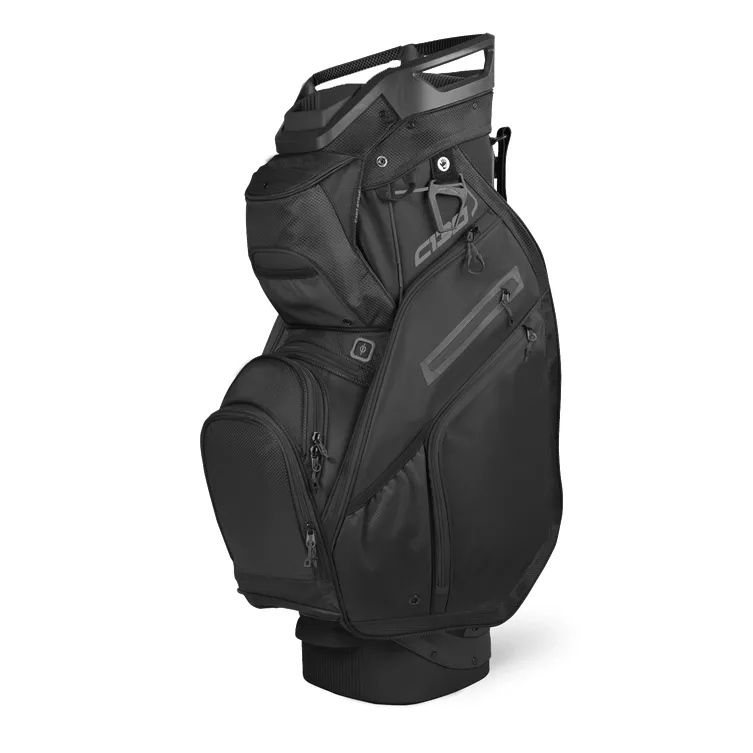
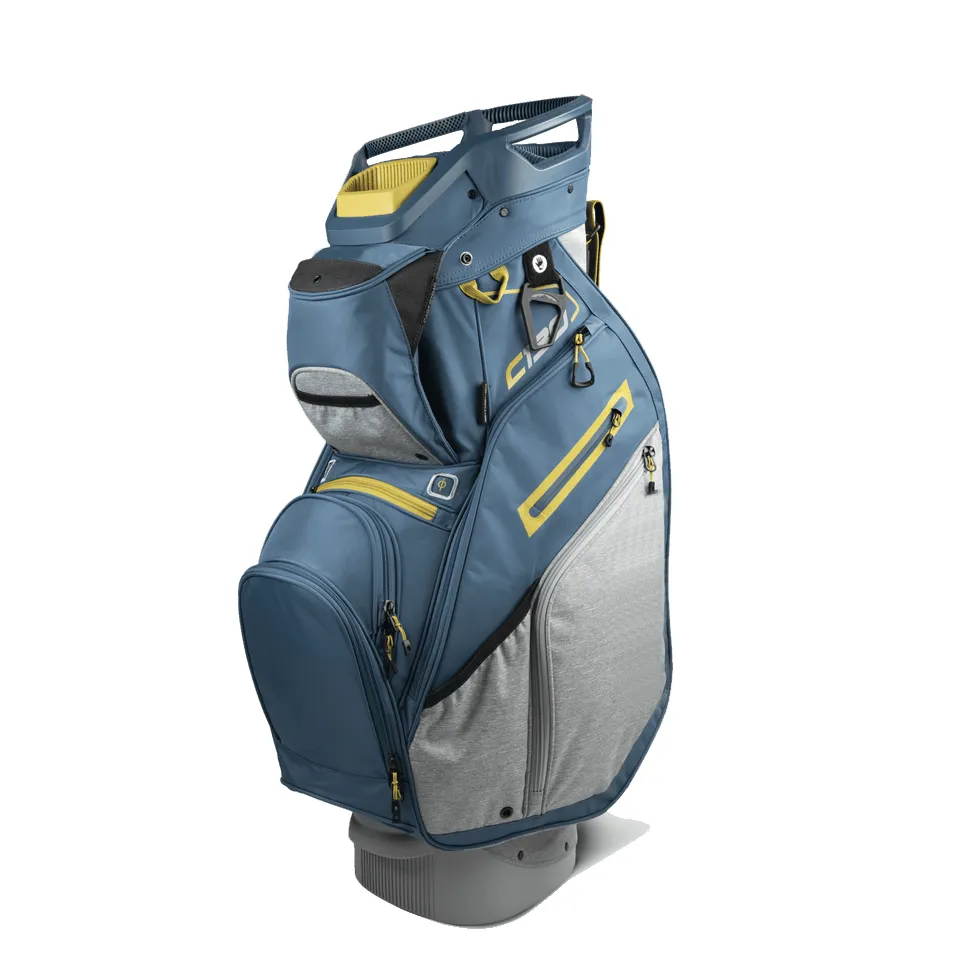
Layout should be drawn from the user's position behind the cart, not from a flat elevation. In practice that means a large ball pocket on the upper front face, a valuables pocket above it with a water-resistant zip, an insulated pocket on the lower side where it stays out of the sun, and an apparel pocket on the reverse face. The rangefinder pocket, where fitted, belongs on the side facing the player at the top of the bag.
Zip direction follows the same logic. Zips should open away from the direction of travel so rain does not drive into the coil, and pulls should sit where a right-handed user reaches naturally. Getting this wrong is cheap to fix on paper and impossible to fix after tooling.
Ordering path for cart bag programmes
The six steps run from brief to shipment, with a first programme on new tooling typically at 13–17 weeks. Material trade-offs are set out under custom bag materials, and sourcing logistics are covered on sourcing bags from China.
Send a pocket stack and divider layout and you will receive a tooling estimate, a base recommendation and an indicative FOB band within 48 hours. Insulated pocket construction is also discussed on the custom tote bags page.