Your Trusted Custom Den Caddie Bags Manufacturer
Den caddie bag manufacturing for premium golf programs, with structured panels, clean embroidery zoning, and repeatable finishing for club and retail collections.
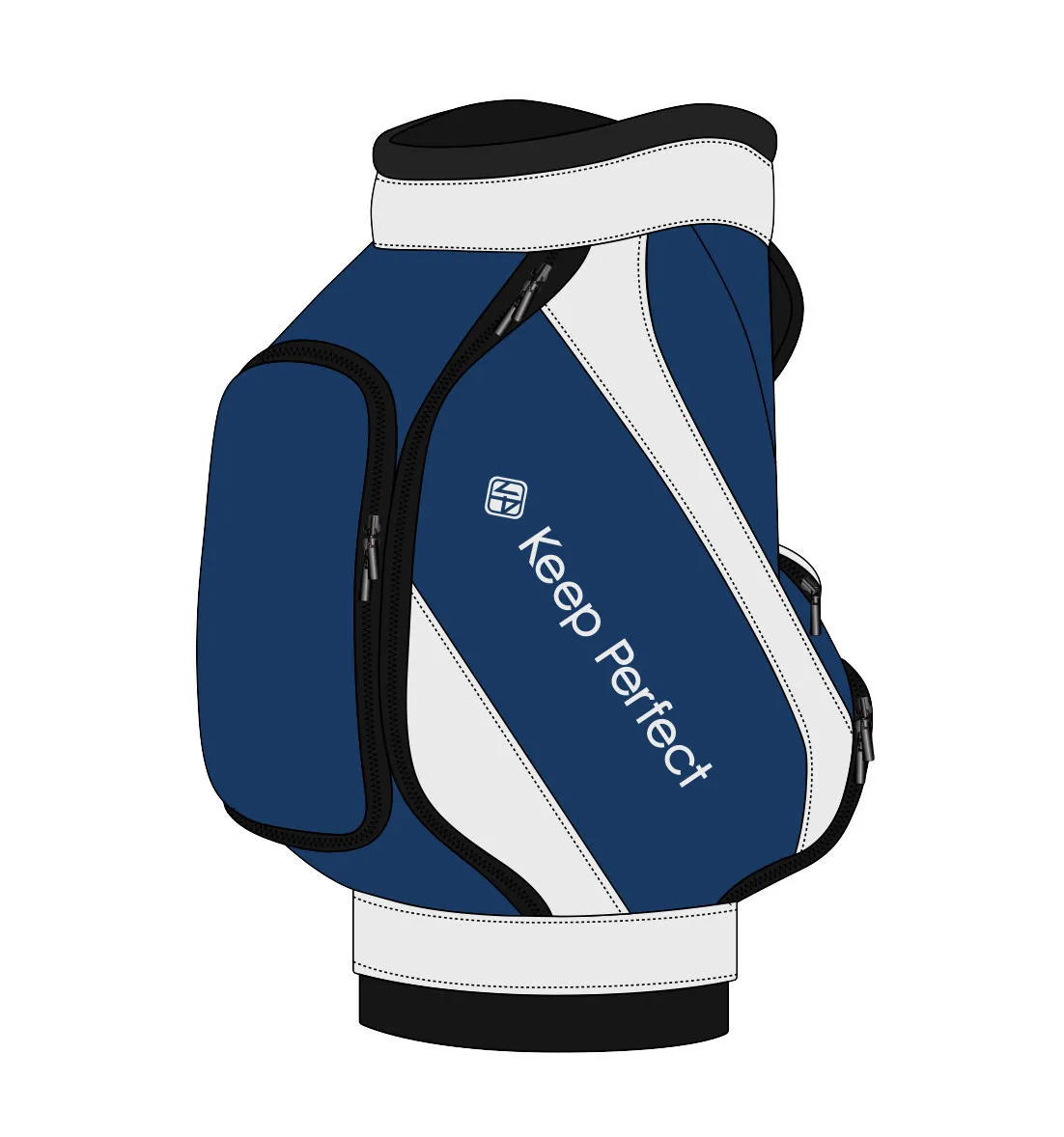
Spec snapshot
A fast engineering view of what matters for sourcing, quoting, and repeatable production.
| Item | Typical | Notes |
|---|---|---|
| Positioning | premium / event / club programs | Define channel early to lock branding zones and packaging |
| Structure feel | high structure silhouette | Boards and cuff parts control feel and appearance drift |
| Branding package | large embroidery + patches (by spec) | Needs placement templates and stitch density approvals |
| Pocket zoning | apparel / valuables / cooler (by spec) | Zoning reduces pocket interference and bulge |
| Typical MOQ | 500–800 pcs | Depends on materials, structure parts, and logo complexity |
Tour branding zones
Staff bags are brand billboards. These zones standardize logo methods and the controls that keep alignment consistent in bulk.
| Zone | Method | Risk | Control |
|---|---|---|---|
| Front panel | embroidery / patch | curve distortion | panel jig + placement template approval |
| Side panel billboards | large embroidery | seam misalignment | alignment gates and stitch-path verification |
| Top cuff / collar | deboss/patch (by spec) | finish drift | master sample board + incoming checks |
| Accessory pockets | labels / small logos | visual clutter | zoning rules and spacing plan |
Staff bag structure parts
Tour-level silhouettes are built from structure parts. This map keeps feel, alignment, and durability consistent across bulk runs.
| Part | Purpose | Risk | Control |
|---|---|---|---|
| Top cuff build | stable opening + premium feel | tilt and rattle | tolerance checks and assembly fixtures |
| Body boards | straight silhouette | wrinkle / waviness | board placement templates and symmetry gates |
| Base reinforcement | wear control | abrasion through | skid panel strategy and corner reinforcement |
| Handle set | lift + cart handling | tear-out | reinforcement map and pull tests |
Tournament program operations
Event programs fail at operational details: variants, personalization, accessories, and packout. This playbook keeps shipments consistent.
| Operation | Risk | Control |
|---|---|---|
| Logo variants | wrong artwork files | SKU-based file naming + proof checklist |
| Name personalization (by spec) | wrong names | list reconciliation + photo proof gate |
| Accessory kit packout | missing parts | packing list reconciliation and carton marks |
| Premium packaging | scuffs / deformation | protective wrap + carton spacing rules |
Capacity & dimensions reference
Standard size options for den caddie bags. We can also customize dimensions to fit your specific gear.
| Volume | Typical Dimensions | Best For |
|---|---|---|
| Caddie / tour shape | high structure body | event gifting and premium brand series |
| Caddie + cooler pocket (by spec) | insulated pocket zoning | club programs and tournament kits |
| Caddie + accessory kit (by spec) | hood + tag + towel | complete retail packouts |
Materials & fabrics
Material choice drives performance, durability, finishing, and target price point.
| Fabric | Waterproof | Cost | Notes |
|---|---|---|---|
| PU leather / microfiber leather | depends on finish | varies | Premium appearance; needs grain and color control. |
| Premium polyester/nylon | water-resistant options | varies | Durable shells with structured support. |
• appearance checks
• AQL final inspection
• Tournament gifting
• Premium retail collections
• Branding zones + artwork files (embroidery density expectations by spec)
• Material preference (PU/microfiber/textile) and finish tolerance
• Pocket zoning priorities (apparel/valuables/cooler by spec) and accessory kit list
• Hardware finishing tone and any corrosion-aware requirement (by market)
• Packaging spec and whether personalization is required (by spec)
Start custom den caddie bags production
Send your requirements and get a structured RFQ checklist and a manufacturing plan.
A cart-side caddie bag is a structured organiser that hangs off a frame and has to work one-handed: drinks in insulated pockets, small items in reach, and nothing that swings, drains onto the user or drops out when the frame moves. Structure and attachment do the work here, not fabric area.
Specification options for caddie bags
Two decisions dominate the specification. The first is how the bag attaches, because that is a tooling item. The second is how much of the interior is insulated, because every insulated pocket adds panel count, welding and weight. The tiers below are the configurations most buyers settle on.
| Parameter | Compact 8 L | Standard 12 L | Deluxe 16 L |
|---|---|---|---|
| External dimensions | 24 × 16 × 26 cm | 28 × 18 × 30 cm | 32 × 20 × 33 cm |
| Total capacity | 8 L | 12 L | 16 L |
| Insulated capacity | 2 pockets, 4 cans each | 2 pockets, 6 cans each | 3 pockets, 6 cans each, 1 dry |
| Shell fabric | 420D polyester, PU | 600D polyester, PU + DWR | 900D polyester, TPU back, wipe-clean |
| Insulation | 5 mm PE foam, foil facing | 6 mm PE foam, taped joints | 8 mm PE foam plus radiant barrier |
| Attachment | Two hook-and-loop straps | Moulded hook plus strap | Moulded hook, strap and lower stabiliser |
| Closure | #8 coil | #10 coil, water-resistant | #10 water-resistant, storm flap |
| Empty weight | 620 g | 900 g | 1,250 g |
| Extras | 1 drain grommet | 2 drain grommets, key clip | 2 grommets, removable liner, tool sleeve |
| Documented compliance | REACH (EC 1907/2006), Proposition 65 | REACH, CPSIA, FDA 21 CFR liner | REACH, CPSIA, FDA 21 CFR, amfori BSCI |
Attachment geometry has to be agreed before anything else is quoted. A moulded hook is the cleanest solution and the most durable, but it is a tooled part; a strap-based attachment avoids tooling and shifts the load into stitching. If the bag will be carried loaded off the frame, the attachment has to be rated for carrying, not just for hanging.
How a caddie bag is assembled
Structure comes before pockets. The body is built around a stiffener panel in the back and the base so the bag holds its shape when empty, because a caddie that collapses flat is awkward to load and looks poor on a shelf. Stiffener is inserted between shell and lining and tacked at the seam line so it cannot rotate.
The attachment is the load path. A moulded hook is riveted and stitched to a reinforcement plate that spans the back panel and continues into the base seam, so the weight of a full bag travels into the base rather than into one panel of fabric. Where a strap system is used, the strap is continuous around the body and is anchored at the same two points.
Insulated pockets are built as welded boxes and set into the body before the lining closes. Each pocket is welded, leak-tested, and then insulated on the outer faces; the pocket mouth is finished with a bound edge so it can be wiped. Drainage is planned at pattern stage: a grommet at the lowest point of each insulated pocket, checked for blockage during inspection.
Access geometry decides whether the bag is pleasant to use. Pockets that open away from the user when the bag is mounted are the most common design error. We set pocket mouths and zip runs so that a mounted bag opens toward the user, and we specify zip pulls large enough to be operated one-handed.
Interior finishing is a cleaning question. Liners are laminated and wipeable, seams inside insulated pockets are welded not sewn, and on the deluxe build the liner is removable so it can be rinsed. A bag that cannot be cleaned is a bag that gets replaced, which is good for nobody except the discount channel.
Cost drivers and MOQ for caddie bags
Attachment tooling is the headline cost, at USD 300–2,500 depending on whether the hook is a single cavity or a family of parts. After that come insulated pocket count, stiffener specification, shell denier and hardware. Pocket count is the variable to adjust when a price target has to be hit, because each insulated pocket is a welded sub-assembly.
We take programmes from 500 units per style per colour, and 300 where the style has already run and the tooling exists. Sampling is 6–10 working days for a strap-attached build and 12–15 where a moulded hook is tooled. Sample fees are USD 50–150, credited against the first bulk order.
| Tier | Typical configuration | Indicative FOB |
|---|---|---|
| Compact | 420D shell, 2 insulated pockets, strap attachment | USD 6.50–9.00 |
| Standard | 600D shell, 2 pockets, moulded hook, drain grommets | USD 9.00–12.00 |
| Deluxe | 900D shell, 3 pockets, stabiliser, removable liner | USD 12.00–15.00 |
Commercial terms are T/T 30/70, FOB Xiamen, with EXW, CIF and DDP available and Incoterms 2020 applied by default. Indicative pricing reaches you in 24–48 hours. Transit is 25–35 days by sea, 5–8 days by air and 3–5 days by courier; structured bags cube large, so a 40HQ at roughly 68 CBM is the usual choice above 2,500 units.
Quality gates and acceptance criteria
Batches are released against AQL 2.5 per ISO 2859-1 — Critical 0, Major 2.5, Minor 4.0 — and AQL 1.5 where a retail customer requires it. Inspection is carried out on our 4,950 m² SGS-verified production floor before loading, and the same plan is applied to reorders so season-on-season comparisons hold.
The tests that predict field life on this product are the attachment load test, the mount cycle and the leak test on insulated pockets. A hook that passes a static pull but cracks after repeated mounting cycles will fail in the field, so both are run. Liner film is documented to FDA 21 CFR food-contact requirements and coated fabrics are screened to REACH (EC 1907/2006).
| Check | Method | Acceptance |
|---|---|---|
| Attachment static load | In-house, 15 kg, 60 s | No crack, no plate tear, deflection under 3 mm |
| Mount and release cycle | In-house jig, 5,000 cycles | No hook crack, strap retains grip |
| Insulated pocket leak | In-house, filled, 30 min on side | No drip at weld or grommet |
| Shell tensile and seam | ASTM D5034, ISO 13934-1 | Above 450 N fabric, above 190 N seam |
| Loaded drop | ISTA 3A, 10 kg, 10 drops | No hardware fracture, no seam split |
| Colour fastness to rubbing | AATCC 8 | Grade 4 dry, grade 3–4 wet |
| Hardware corrosion | ASTM B117, 48 h | No red rust on functional surfaces |
Pocket layout, drainage and access geometry
Layout is best settled with a physical mock-up rather than a drawing. Insulated pockets belong on the side that faces the user when the bag is mounted; dry storage belongs above them, because anything at the bottom of a hanging bag becomes hard to reach. A tool or accessory sleeve on the outer face is cheap to add at sampling and expensive to add after tooling.
Drainage is the detail that decides whether the bag smells after a season. Every insulated pocket needs a path out, and that path has to exit clear of the attachment and clear of the user. Grommets are set at the lowest point, tested for blockage at inspection, and positioned so meltwater does not run down the mounted frame.
Ordering path for caddie bag programmes
Count 10–14 weeks for a first programme where a moulded attachment is tooled, and 8–11 weeks for a strap-attached build.
Send a sketch of the mounting point, the contents the bag has to hold and your target price, and we will return a build grid, an attachment recommendation with tooling estimate and an indicative FOB band inside 48 hours. Structure and insulation choices are compared on custom bag materials, and tooling economics are explained on cost and MOQ.