Your Trusted Custom Cosmetic Bags Manufacturer
Cosmetic bag and toiletry pouch manufacturing for beauty brands, travel kits, and retail gift sets. Built for clean finishing, wipe-clean liners, and reliable zippers.
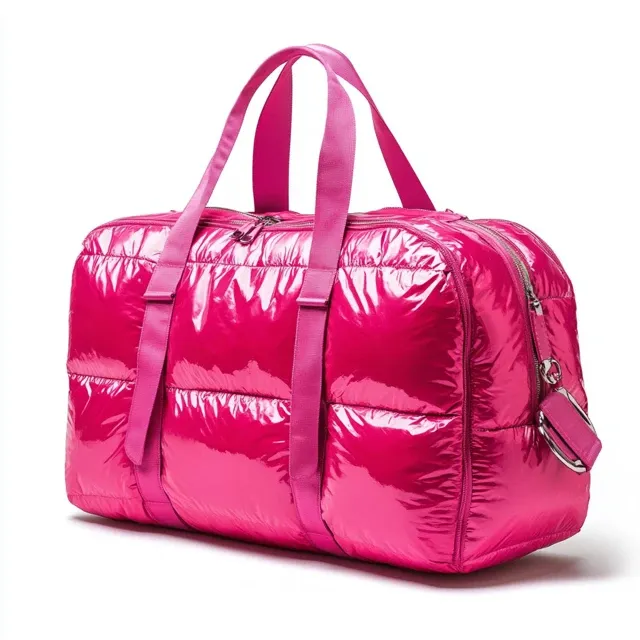
Spec snapshot
A fast engineering view of what matters for sourcing, quoting, and repeatable production.
| Item | Typical | Notes |
|---|---|---|
| Bag type | pouch / boxy bag / hanging toiletry (by spec) | Type defines structure panels and zipper geometry |
| Spill tolerance | basic wipe-clean / high spill control (by spec) | Define liner material and seam strategy early |
| Organization level | minimal / brush holders / bottle loops | Organization adds labor; design it around real items |
| Typical MOQ | 500–3000 pcs | Depends on printing, custom colors, and set packaging |
Organizer layout (what customers actually store)
Cosmetic bags are sold by organization. Define your product line (travel, daily, gift set) and we will map the layout to real items.
| Compartment | Best for | Notes |
|---|---|---|
| Main cavity | bottles and bulky items | Rounded corners reduce trapped residue and improve cleaning |
| Elastic loops | bottles, tubes, travel-size items | Control elastic tension to avoid loose fit after repeated use |
| Brush panel | makeup brushes | Add protective flap to reduce powder contamination |
| Zipper mesh pocket | small accessories | Mesh visibility helps usability; check tear resistance |
Spill control & wipe-clean design
Spills and leakage are the biggest cause of dissatisfaction. This section clarifies liner, seam, and zipper choices that keep the bag clean in daily use.
| Zone | Strategy | Notes |
|---|---|---|
| Liner seams | reduce seam exposure + seal strategy (by spec) | Corners are common leakage points; optimize fold geometry |
| Bottom panel | wipe-clean liner + reinforcement | Define base structure to keep shape and reduce pooling |
| Zipper path | zipper level selection + end reinforcement | Zipper ends collect residue; align cleaning expectations |
• If the bag is used for liquids, specify spill tolerance and cleaning frequency in the tech pack.
• Define color transfer tolerance for light-colored liners and printed fabrics.
Materials & fabrics
Material choice drives performance, durability, finishing, and target price point.
| Fabric | Waterproof | Cost | Notes |
|---|---|---|---|
| Polyester / nylon | water-resistant options | varies | Stable for printing and daily use. |
| PU leather | depends on finish | varies | Easy cleaning and premium look for retail positioning. |
| TPU/PEVA liner | leak-resistant options | varies | For wipe-clean interiors and spill control. |
• stitch strength spot checks
• wipe-clean validation by sampling plan (by spec)
• AQL final inspection
• Travel toiletry kits
• Retail private label cosmetics accessories
• Spill tolerance and liner preference (wipe-clean requirement)
• Organization needs (brush panel, loops, pockets) and target item list
• Fabric preference and branding method (print/patch/emboss)
• Set packaging requirements (gift set, insert, barcode labels)
• Any compliance or claims scope for your market copy
Start custom cosmetic bags production
Send your requirements and get a structured RFQ checklist and a manufacturing plan.
A cosmetic pouch is judged on things a spec sheet rarely mentions: whether the zip runs around the corner without catching, whether the lining can be wiped after a foundation spill, and whether the bag stands up on a shelf instead of listing to one side. All three are decided by pattern geometry and lining choice long before sewing starts.
Specification options for cosmetic and toiletry bags
Three body styles cover most programmes: a flat pouch for gift-with-purchase and sample kits, a boxy kit with a gusset for retail shelves, and a hanging toiletry build with a hook for travel. The grid below sets out where each one lands.
| Parameter | Flat pouch | Boxy kit | Hanging toiletry |
|---|---|---|---|
| External dimensions | 22 × 15 cm, no gusset | 24 × 16 × 10 cm | 26 × 20 × 11 cm, folded 26 × 20 × 6 cm |
| Shell fabric | 210D polyester or clear TPU | PU-coated 420D or quilted polyester | 600D polyester, PU + DWR |
| Lining | 190T undyed, wipe-clean | PEVA laminate, welded seams | 210D ripstop with TPU laminate |
| Closure | #3 coil, single pull | #5 coil, double pull | #5 coil plus #3 internal |
| Gusset construction | None, piped edge | Boxed corners, 50 mm | Boxed corners plus internal frame panel |
| Internal organisation | Open | 4 elastic loops, 1 mesh slip | 8 loops, 2 zip pockets, brush panel |
| Empty weight | 55 g | 160 g | 340 g |
| Hardware | None, or TPR pull | Metal pull, moulded foot studs | Metal hook, swivel, 2 studs |
| Branding | 1-colour screen | Woven label plus debossed badge | Embroidery plus woven label |
| Documented compliance | REACH (EC 1907/2006), Proposition 65 | REACH, CPSIA, Proposition 65 | REACH, CPSIA, EN 71-3, amfori BSCI |
Wipe-clean lining is the specification that separates a bag a customer keeps from one they throw away after a spill. A laminated PEVA or TPU lining costs more than a plain 190T nylon and complicates the seam, because a laminate does not ease around corners the way woven fabric does. It is also the single upgrade most likely to show up in your review scores.
How a cosmetic bag is put together
Body geometry comes first. A flat pouch is two panels and a binding; a boxy kit needs a gusset with mitred or boxed corners, and the corner method decides whether the bag stands square. Boxed corners give a flat footprint and read better on a shelf; piped corners give a softer shape that packs better inside luggage.
Zipper installation is the most common source of returns on this product. The tape has to be eased around the corner, which means the shell pattern must include a notch or a relief dart at each end of the zip run. Without it, the zip either puckers visibly or binds at the corner, and a bound slider will separate the tape within a few hundred cycles.
Lining is assembled as a separate unit and dropped in, then joined at the zip line only. For laminated linings, internal seams are welded or taped instead of sewn, because a needle hole through a laminate is a leak path. Where a sewn seam is unavoidable, we tape over it from the inside.
Internal organisation is set before the lining closes: elastic loops are cut to a specified relaxed length, not to the tube diameter, and they are anchored with a bar-tack rather than a single pass of straight stitch. Brush panels get a hemmed top edge, because a raw elastic or webbing edge is the part a customer touches every day.
On a hanging build, the hook is a structural item. It carries the full weight of a loaded kit off a door or a rail, so the hook attaches to a webbing strap that runs down the back panel and into the base seam, not to a fabric tab. The panel behind it is reinforced, and the hook is load-tested on the first-piece sample.
Cost drivers and MOQ for cosmetic bags
Price is driven by lining specification, zipper gauge and brand, corner construction, hardware and print. A flat pouch at 500 units is a very different product from a hanging kit at the same quantity: the kit has four times the panel count, a hook, elastic work and a frame panel, and that shows up directly in the unit price.
Runs begin at 500 pieces per style per shade; repeat styles drop to 300. Sampling is 6–10 working days for a stock pattern, or 12–15 where a new shape, a custom zip pull or a moulded hook is involved, with tooling charges of USD 300–2,500. Sample fees run USD 50–150 and are credited against the first bulk order.
| Tier | Typical configuration | Indicative FOB |
|---|---|---|
| Flat pouch | 210D or clear TPU, #3 zip, piped edge, 1-colour print | USD 1.60–2.60 |
| Boxy kit | Coated 420D, laminated lining, #5 zip, elastic loops | USD 2.60–3.80 |
| Hanging toiletry | 600D shell, hook and swivel, 2 zip pockets, embroidery | USD 3.80–5.50 |
Payment is T/T 30/70, delivery FOB Xiamen, with EXW, CIF and DDP available and Incoterms 2020 applied as standard. Quotes are returned in 24–48 hours. Transit: 25–35 days by sea, 5–8 by air, 3–5 by courier; a 40HQ at roughly 68 CBM is often the efficient choice once a set programme exceeds 4,000 pieces.
Quality gates and acceptance criteria
Each batch is sampled to AQL 2.5 under ISO 2859-1 with Critical 0, Major 2.5 and Minor 4.0, and AQL 1.5 is offered where a beauty retailer sets its own standard. Cosmetic criteria are agreed in advance with photographic limits, because on a small pouch a 1 mm print misregistration is visible in a way that would be acceptable on a backpack.
Functionally, the checks that predict returns are zipper endurance, coating adhesion on laminated linings and the hook load on hanging builds. Compliance covers REACH (EC 1907/2006) on coated fabric and trim, CPSIA and California Proposition 65 for the US, and EN 71-3 where a pouch is marketed to children.
| Check | Method | Acceptance |
|---|---|---|
| Zipper endurance | In-house, 2,000 open and close | No binding, no tape separation |
| Coating adhesion | ASTM D751, laminated lining | No delamination after flex and tape pull |
| Hook and strap load | In-house, 10 kg static, 60 s | No panel tear, hook stays seated |
| Seam strength | ISO 13934-1 | Above 140 N on shell seams |
| Wipe-clean check | In-house, soiled and wiped, 20 cycles | No staining, no coating lift |
| Colour fastness to rubbing | AATCC 8 | Grade 4 dry, grade 3–4 wet |
| Restricted substances | REACH (EC 1907/2006), CPSIA, EN 71-3 | Within limits for destination market |
Set building, packaging and labelling for pouch programmes
Cosmetic programmes are usually bought as sets: two or three sizes sharing a fabric, a print and a trim package. Building them as one programme rather than three separate ones matters, because fabric is dyed in a single lot, print registration is matched across sizes, and the unit cost falls with shared cutting markers.
Packing is part of the product here. Sets can be nested in a printed sleeve, boxed with a divider, or shipped flat with a belly band, and each option changes both the freight cube and the shelf impression. Care and content labelling is assembled to the destination market, and fibre or coating declarations are taken from the same material file used for compliance testing.
Ordering path for cosmetic bag programmes
First programmes usually ship in 8–11 weeks. Custom zip pulls and moulded hooks are the items that add time, so decide those at brief stage.
Send a dimensioned sketch, a target price and the number of sizes in your set, and we will return a build grid, a lining recommendation and an indicative FOB band within 48 hours. Material comparisons sit on custom bag materials, and packaging options are described under private label programmes.