Your Trusted Custom Travel Bags Manufacturer
Travel bag manufacturing for carry-on, weekender, and multi-pocket travel programs. Built for durable zippers, clean finishing, and repeatable bulk execution.
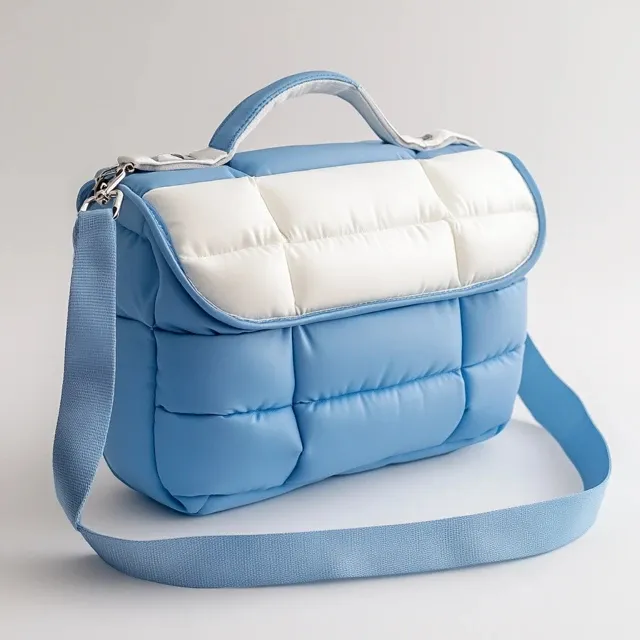
Spec snapshot
A fast engineering view of what matters for sourcing, quoting, and repeatable production.
| Item | Typical | Notes |
|---|---|---|
| Travel style | weekender / carry-on / personal item (by spec) | Style defines dimensions, handles, and pocket strategy |
| Access architecture | U-zip / clamshell / top-load | Access system changes zipper length and assembly complexity |
| Durability target | regular travel / heavy travel / rough handling | Defines fabric grade, base reinforcement, and hardware selection |
| Pocket architecture | minimal / organizer heavy | Pocket count and lining are major cost and assembly drivers |
| Typical MOQ | 500–800 pcs | Depends on custom fabrics, branding, and hardware options |
Carry-on sizing guidance (by market)
Travel bags should be designed around common cabin constraints and real packing volume. Final compliance depends on the carrier, but design targets reduce returns.
| Market | Typical cabin limits | Bag size target | Notes |
|---|---|---|---|
| USA (typical) | varies by carrier | carry-on and weekender proportion targets | Confirm target carriers; define tolerance early |
| EU (typical) | varies by carrier | compact carry-on proportions | Budget carriers often require smaller profiles |
| UK (typical) | varies by carrier | carry-on and personal-item profiles | Personal-item programs benefit from rigid dimension control |
| Asia (typical) | varies by carrier | lighter weight focus | Weight limits can be more sensitive; define total weight target |
Scenario benchmarks
Travel bags are spec’d from the scenario: airport handling, hotel transitions, and packing behavior. This table keeps the design on-track.
| Scenario | Typical load | Design focus |
|---|---|---|
| Weekend city trip | 2–3 outfits + toiletries | easy access + clean finishing + carry comfort |
| Business travel | laptop + documents + change of clothes | organization + premium look + stable hardware matching |
| Adventure travel | mixed gear + frequent packing | abrasion control + base reinforcement + zipper durability |
Capacity & dimensions reference
Standard size options for travel bags. We can also customize dimensions to fit your specific gear.
| Volume | Typical Dimensions | Best For |
|---|---|---|
| 25L - 35L | 50 x 26 x 26 cm (typical) | weekend and gym crossover |
| 40L - 55L | 60 x 30 x 30 cm (typical) | carry-on weekender travel |
Materials & fabrics
Material choice drives performance, durability, finishing, and target price point.
| Fabric | Waterproof | Cost | Notes |
|---|---|---|---|
| Polyester / nylon | water-resistant options | varies | Flexible for travel bags with stable hand-feel. |
| 1680D ballistic nylon | water-resistant | varies | Abrasion control for heavy travel and premium positioning. |
| TPU coated fabric (by spec) | water-resistant to waterproof | varies | Easy cleaning and stronger weather protection. |
• zipper function cycle checks (by spec)
• drop test (by spec)
• AQL final inspection
• Corporate gifting: branded travel bags with packaging alignment.
• Travel DTC brands: modular organization and repeatable bulk quality.
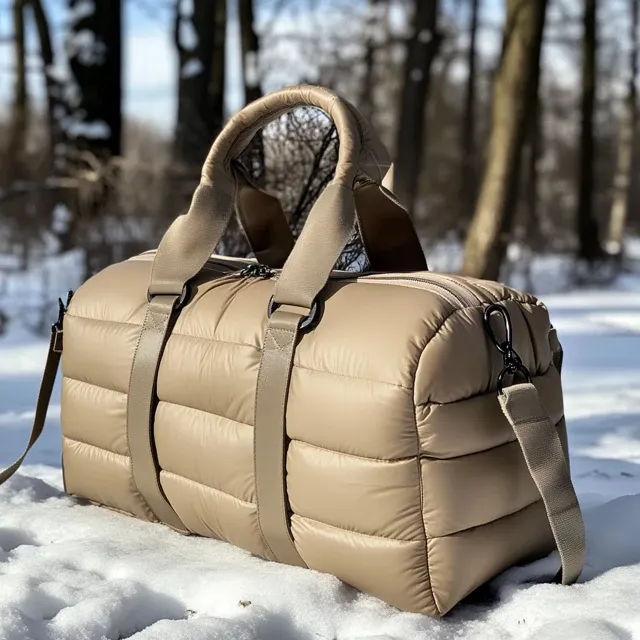
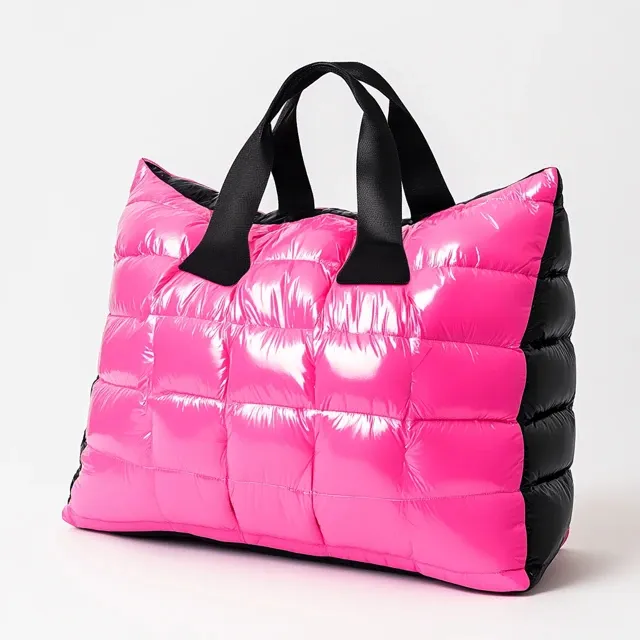
• Dimension constraints and tolerance expectations
• Pocket architecture and access style preference
• Fabric and base reinforcement preference + durability target
• Zipper gauge and any branded zipper pulls
• Branding method and packaging requirements
Start custom travel bags production
Send your requirements and get a structured RFQ checklist and a manufacturing plan.
Specification options for duffel-format travel bags
A duffel is the simplest bag in any travel range and the easiest to get wrong. There is no frame, no harness, and no structure beyond the base panel, which means every load travels through the handle and the main zip. Programmes in this category succeed when the base, the zip corridor, and the handle wrap are specified properly, and fail when capacity is treated as the only number that matters.
| Specification | Standard range | Development notes |
|---|---|---|
| External dimensions | 45 × 25 × 25 cm to 75 × 35 × 38 cm | Length set against boot, kit, or garment-fold volume |
| Usable capacity | 25–90 L | Nominal figures overstate usable volume by 10–15 percent |
| Shell materials | 600D and 900D polyester, 1680D nylon, 12–16 oz canvas, TPU laminate | Coating weight 0.10–0.18 mm on laminated builds |
| Base structure | 4–6 mm board, moulded feet, 5–8 studs, wipe-clean panel | Board prevents the base folding when half loaded |
| Main closure | #8 or #10 coil zip with storm flap, U-shaped or straight run | Corner radius drives slider tracking |
| Handle system | Wrap-around webbing 25–38 mm with padded grip, hook-and-loop keeper | Wrap carries the floor, not the seam |
| Shoulder strap | Detachable 38–50 mm padded strap, 80–140 cm adjustable | Attachment points need reinforcement patches |
| Compliance lines | REACH (EC 1907/2006), California Proposition 65, OEKO-TEX Standard 100, CPSIA | Selected by destination and end-user age group |
Capacity should be quoted as a measured figure rather than a nominal one. A duffel that is nominally 60 L usually delivers closer to 50 L of usable space once the base board, end panels, and pocket structures are accounted for, and publishing the inflated number is the fastest route to a customer complaint.
The main zip corridor deserves more specification attention than any other component. A U-shaped run lets the bag open wide for packing but places two tight corners in the path of the slider, so the corner radius should be drawn generously and the tape stabilised with binding or tape before assembly. Straight runs are cheaper and more reliable but restrict access, which matters on gym and sport programmes.
How duffel-format travel bags are built
Pattern work begins with the end panels. Rounded ends give the classic duffel silhouette and pack well, but they waste floor space when the bag stands upright and push the zip into a compound curve. Squared ends with a small radius stand better, hold shape when empty, and make the main opening easier to sew.
The base assembly carries everything. A 4–6 mm board in a sleeve keeps the floor flat so the bag does not fold around its contents and spreads point loads from boots or training kit. Feet sit inboard of the wall line and are through-fixed, and outdoor programmes cut the base panel from a heavier or coated fabric so it can be set on wet ground without wicking.
Handles are normally wrap-around webbing continuing beneath the base, so the floor carries the weight and the stitching is secondary; a hook-and-loop keeper holds the halves together. The grip should be padded, since bare 25 mm tape under 15 kg becomes uncomfortable within minutes.
End compartments are where duffels earn a premium. A shoe or wet compartment is a separate zip pocket at one end, lined in wipe-clean PEVA with a vent eyelet and a drain path that does not exit through the main cavity. Sealing the lining seam properly is the difference between a useful wet pocket and a leak into the body.
Shoulder straps convert a hand-carry duffel into a travel bag. Attachment should be at two reinforced points on the end panels rather than the handle, with a padded section of at least 38 mm and a swivel clip to stop twisting. Heavier programmes specify a detachable harness instead, which changes the reinforcement layout and must be decided before the first pattern.
Cost drivers and MOQ for duffel-format travel bags
Unit price moves with fabric and coating, base board or moulded tray, zip length and chain size, compartment count, and labour in lining and binding. Compartment labour is the dominant variable: a duffel with a shoe pocket, two end pockets, and a lined main body can take 50–70 percent longer to assemble than a single-cavity bag of identical size.
| Construction | Typical build | Indicative unit price (USD) |
|---|---|---|
| Light gym duffel, 25–35 L | 600D shell, straight zip, webbing handles | 6.50–10.50 |
| Standard travel duffel, 40–55 L | 900D shell, base board, wrap handle, shoulder strap | 9.00–15.00 |
| Duffel with shoe compartment | 900D shell, PEVA-lined end pocket, vent | 12.00–19.00 |
| Large expedition duffel, 70–90 L | 1680D shell, moulded base, harness attachment points | 16.00–26.00 |
| Premium canvas or leather duffel | 16 oz canvas or full-grain leather, metal feet, branded hardware | 24.00–48.00 |
Minimums start at 500 units per style per colour and fall to 300 for repeat programmes once the pattern is proven. Sampling takes 6–10 working days on sewn builds and 12–15 where welded linings, moulded trays, or bonded panels are used; mass production occupies 35–50 days after written sample approval. Quotations are returned within 24–48 hours, payment runs T/T 30/70, and pricing is quoted FOB Xiamen with EXW, CIF, or DDP available.
Sample fees of USD 50–150 are credited against the first bulk order, with tooling for custom pulls, feet, or logo plates at USD 300–2,500. Empty duffels nest reasonably well, but base boards and trays do not: a 20GP holds roughly 28 CBM, a 40GP about 56 CBM, and a 40HQ close to 68 CBM, with transit at 25–35 days by sea, 5–8 days by air, and 3–5 days by courier.
Quality gates and acceptance criteria
Incoming material control covers fabric weight, coating adhesion under ASTM D751, shade banding, foam density, and hardware finish. Woven shells are sampled for grab strength per ASTM D5034 and seam tensile behaviour per ISO 13934-1, while coated shells claiming weather resistance are checked for spray rating per AATCC 22 and hydrostatic resistance per AATCC 127.
Assembly inspection concentrates on the main zip corridor and the handle wrap. Inspectors verify slider travel around both corners, top stop anchoring, binding coverage over the tape, and symmetry between the two handle halves. Each line runs a static load check on first pieces, filling the bag to rated capacity and lifting it by the handles for a fixed number of cycles to confirm no seam creep.
Wet compartments are leak-tested as a separate operation before final assembly, since a failed seal discovered at final inspection means scrapping the unit. Final inspection runs at AQL 2.5 under ISO 2859-1 with Critical 0, Major 2.5, and Minor 4.0, and AQL 1.5 on request. Critical classification covers split zip corridors, detached handle wrap, leaking wet pockets, and missing or loose feet.
Shoe compartments and wet-pocket separation
A shoe compartment only works if it is genuinely isolated from the main cavity: a lined pocket with sealed or bound seams, an entry on the exterior, and a vent path that exits through an eyelet or mesh panel rather than into the body of the bag. Skip the vent and condensation builds up inside the pocket, which looks like a leak to the customer.
Sizing the pocket is equally concrete: it should be dimensioned against the largest shoe size in the range rather than an average, and it should sit at the end panel so it does not steal depth from the main cavity. Where tooling is shared with gym bag programmes, the pocket is often given a wipe-clean lining and drain path so one pattern serves both.
Ordering path
Six stages from brief to loaded container.